
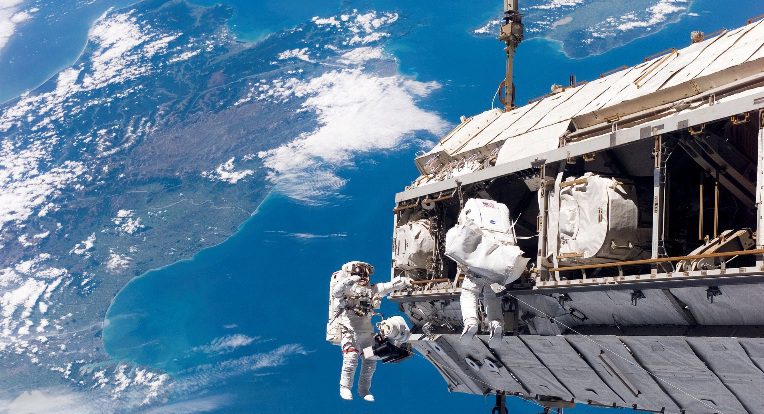
Image by NASA-Imagery from Pixabay
The Final Frontier’s New Phase: International Space Station Technology 2026
For over a quarter-century, the International Space Station has been the undisputed crown jewel of human engineering in low-Earth orbit (LEO). However, in April 2026, the narrative around International Space Station Technology 2026 has taken a dramatic turn. We are no longer just talking about experiments; we are witnessing the beginning of the end for the current station and the high-stakes birth of its commercial successors.
From the successful splashdown of the Artemis II crew on April 10 to the heated debates in the UK and US over the station’s “destructive reentry,” here is a deep dive into the technology and policy shaping the ISS today.
The “Deorbit” Controversy: Technology vs Heritage
The most significant trend in International Space Station Technology 2026 is the finalized plan for the station’s retirement. NASA has recently awarded a contract to SpaceX to develop a specialized “Deorbit Vehicle“, a modified Dragon spacecraft with six times the propellant of a standard model designed to guide the 450-tonne station into a controlled crash at Point Nemo in 2031.
However, April 2026 has seen a surge in political pushback. In the US, the NASA Reauthorization Act of 2026 was recently marked up by the House Science Committee, with an amendment requiring NASA to reassess if parts of the station can be “stored” or repurposed rather than destroyed. This technological debate centers on whether we should vaporize billions of dollars in hardware or find a way to preserve it for future orbital museums or modular recycling.
Axiom Space: The First “Commercial” Attachment
While the base ISS is aging, the International Space Station Technology 2026 landscape is being refreshed by private investment. Axiom Space is currently finalizing the launch of its first commercial module, planned for late 2026.
This module will physically attach to the existing ISS, providing high-speed “Space Internet” and luxury habitation quarters for private astronauts. The goal is simple but ambitious: build a commercial segment that can eventually undock and become its own free-flying station before the ISS is decommissioned. For AdSense publishers, this shift represents a move from “government science” to “orbital commerce,” a major keyword trend in the B2B tech space this year.
3D Printing and In-Space Manufacturing Breakthroughs
A core part of the International Space Station Technology 2026 research portfolio involves turning the station into a factory. This month, researchers have reported significant progress in “Bioprinting,” where human tissue and even simple medical implants are being 3D-printed in microgravity.
Because there is no gravity to cause “particle settling,” these space-manufactured structures are more stable and uniform than those made on Earth. Companies are now looking at the ISS as a testbed for manufacturing high-purity fiber optic cables and advanced pharmaceuticals that simply cannot be replicated in a terrestrial lab. This “In-Space Manufacturing” (InSPA) is the tech trend most likely to drive massive commercial value in the next 24 months.
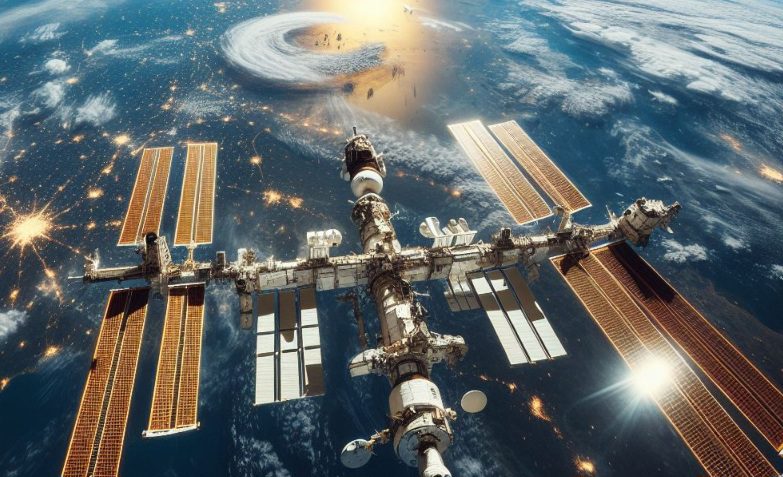
Image by Uzair Ul haq from Pixabay
Edge Computing and AI in Orbit
The station’s internal hardware is also getting a 2026 upgrade. The ISS National Lab recently highlighted breakthroughs in “Orbital Edge Computing”. Instead of sending massive amounts of raw data back to Earth to be processed, which is slow and bandwidth-intensive, new AI-powered servers on the ISS are analyzing data in real-time.
Whether it’s detecting an asteroid before it hits the atmosphere or monitoring the structural health of the station’s trusses, International Space Station Technology 2026 is becoming increasingly autonomous. This mirrors the “Agentic AI” trend we are seeing on Earth, where the system identifies a problem and takes corrective action without waiting for a command from Houston.
Preparing for the “Post-ISS” Gap
The biggest fear in the space community this April is the “Space Station Gap.” If the ISS retires in 2030 and commercial stations like Voyager Space’s Starlab are not ready, the West will lose its permanent foothold in LEO.
To prevent this, NASA’s revised Commercial Low Earth Orbit Destinations (CLD) program is currently awarding new Space Act Agreements this month. These contracts are designed to provide “bridge funding” to ensure that the transition from a government-run laboratory to a privately-owned research hub is seamless.
Final Thoughts: A Legacy in Motion
The International Space Station Technology 2026 is defined by a paradox: we are spending more on its maintenance than ever before, yet we are also building its “coffin.” Whether it ends in a fiery descent over the Pacific or lives on through recycled commercial modules, the technological foundation laid by the ISS is currently powering our return to the Moon through the Artemis campaign.
For tech enthusiasts and investors, the message is clear: the low-Earth orbit economy is no longer a “future” concept, it is a live, thriving market that is currently outgrowing its original home.

Image by WikiImages from Pixabay
Sources and Citations
NASA Official: ISS Transition and Deorbit FAQ
Industry News: SpaceNews – NASA’s Commercial Station Strategy 2026
Tech Research: Ars Technica – Congress Reassesses ISS Deorbit Bill
National Lab: ISS National Lab – Technology Advancement Research Announcement
Also read my analysis on Moving Beyond Chatbots: The Most Impactful Agentic AI Trends 2026